答案:3. (1)由折叠可得$AF = DF$.$\because$点$B(8,6)$,点$D(0,4)$,四边形$OABC$为矩形,$\therefore OA⊥ AB$,$OC = AB = 6$,$OA = BC = 8$,$OD = 4$.设$AF = DF = x$,则$OF = OA - AF = 8 - x$.在$\mathrm{Rt}△ ODF$中,由勾股定理可得$OD^{2} + OF^{2} = DF^{2}$,即$4^{2} + (8 - x)^{2} = x^{2}$,解得$x = 5$,$\therefore OF = 8 - x = 3$,$\therefore$点$F$的坐标为$(3,0)$.
(2)①当点$P$在点$F$右侧时,根据题意得,$AQ = 2t$,$AP = t(0 < t < 5)$,$\therefore FP = AF - AP = 5 - t$,$\therefore S = \frac{1}{2}FP· AQ = \frac{1}{2}(5 - t)× 2t = -t^{2} + 5t$;②当点$P$在点$F$左侧时,根据题意,得$AQ = 2t$,$AP = t(5 < t ≤ 8)$,$\therefore FP = AP - AF = t - 5$,$\therefore S = \frac{1}{2}FP· AQ = \frac{1}{2}(t - 5)× 2t = t^{2} - 5t$.综上所述,$S = \begin{cases} -t^{2} + 5t(0 < t < 5), \\ t^{2} - 5t(5 < t ≤ 8). \end{cases}$
(3)存在.若以$P$,$Q$,$R$,$M$为顶点的四边形是正方形,则以$P$,$R$,$Q$为顶点的三角形为等腰直角三角形,可分情况讨论:
①如图①,$\because$四边形$PQRM$是正方形,$\therefore PQ = QR$,$∠ PQR = 90^{\circ}$,$\therefore ∠ PQA + ∠ BQR = ∠ BQR + ∠ QRB$,$\therefore ∠ PQA = ∠ QRB$.在$△ PAQ$和$△ QBR$中,$\begin{cases} ∠ PAQ = ∠ QBR = 90^{\circ}, \\ ∠ PQA = ∠ QRB, \\ PQ = QR, \end{cases}$ $\therefore △ PAQ ≌ △ QBR(\mathrm{AAS})$,$\therefore AQ = BR = 2t$,$BQ = AP = t$,$\therefore AB = AQ + BQ = 2t + t = 3t = 6$,$\therefore BQ = AP = t = 2$,$\therefore BR = AQ = 2× 2 = 4$,$\therefore Q(8,4)$.$\therefore OP = OA - AP = 8 - 2 = 6$,$\therefore P(6,0)$.$\because CR = BC - BR = 4$,$\therefore R(4,6)$.$\because$四边形$PQRM$是正方形,$\therefore M(4 + 6 - 8,6 + 0 - 4)$,即$M(2,2)$.
②如图②,过点$R$作$RK⊥ OA$于点$K$,则四边形$OCRK$,$RKAB$均为矩形,$\therefore RK = AB = 6$,$∠ BRK = ∠ RKA = 90^{\circ}$.$\because$四边形$PRQM$是正方形,$\therefore PR = QR$,$∠ PRQ = 90^{\circ}$,$\therefore ∠ KRB - ∠ PRB = ∠ PRQ - ∠ PRB$,$\therefore ∠ KRP = ∠ BRQ$.在$△ PKR$和$△ QBR$中,$\begin{cases} ∠ RKP = ∠ RBQ = 90^{\circ}, \\ ∠ KRP = ∠ BRQ, \\ PR = QR, \end{cases}$ $\therefore △ PKR ≌ △ QBR(\mathrm{AAS})$,$\therefore RB = RK = 6$,$KP = BQ = AQ - AB = 2t - 6$,$\therefore OK = CR = BC - BR = 8 - 6 = 2$,$\therefore R(2,6)$,$AK = OA - OK = 6 = 2t - 6 + t$,$\therefore AP = t = 4$,$\therefore P(8 - 4,0)$,即$P(4,0)$,$KP = BQ = 2t - 6 = 2$,$\therefore Q(8,6 + 2)$,即$Q(8,8)$.$\because$四边形$PMQR$是正方形,$\therefore M(4 + 8 - 2,8 + 0 - 6)$,即$M(10,2)$.
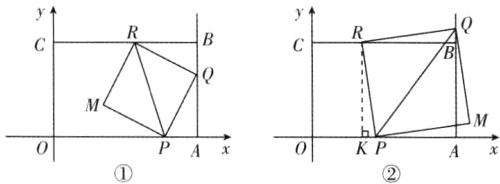
③如图③,$\because$四边形$PQRM$是正方形,$\therefore PQ = QR$,$∠ PQR = 90^{\circ}$,$\therefore ∠ PQA + ∠ BQR = ∠ BQR + ∠ QRB$,$\therefore ∠ PQA = ∠ QRB$.在$△ PAQ$和$△ QBR$中,$\begin{cases} ∠ PAQ = ∠ QBR = 90^{\circ}, \\ ∠ PQA = ∠ QRB, \\ PQ = QR, \end{cases}$ $\therefore △ PAQ ≌ △ QBR(\mathrm{AAS})$,$\therefore AQ = BR = 2t$,$BQ = AP = t$.又$\because AQ = AB + BQ = 6 + t = 2t$,$\therefore AP = t = 6$,$\therefore BR = 2× 6 = 12$,$\therefore Q(8,12)$,$P(8 - 6,0)$,即$P(2,0)$,$\therefore CR = BC + BR = 8 + 12 = 20$,$\therefore R(20,6)$.$\because$四边形$PMRQ$是正方形,$\therefore M(2 + 20 - 8,6 + 0 - 12)$,即$M(14,-6)$.
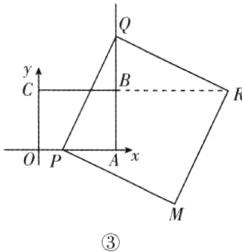
综上所述,存在$M(2,2)$或$M(10,2)$或$M(14,-6)$,使以$P$,$Q$,$R$,$M$为顶点的四边形是正方形.