第二节(共5小题;每小题2分,满分10分)
阅读下面短文,从短文后的选项中选出可以填入空白处的最佳选项。选项中有两项为多余选项。
Lan Lan, a student of Grade Seven in Lushan, was taking a drawing class in a tent on 23 April. Guess what she drew—a house with wings. When the teacher asked why she did so, Lan said if her house could fly, it wouldn't fall down in an earthquake.
Lan's hometown was hit by a strong earthquake on 20 April. At least 196 people were killed and more than 11,000 people got hurt. Many people became homeless.
F
16
Lots of money was sent there to help all those in need.
Although we can't stop an earthquake from happening, we can use some methods to keep safe. During an earthquake, do not jump out of tall buildings because it is very dangerous.
D
17
If there is no safe place for hiding, you can also stay by a wall, and cover your head and neck with your arms and hands.
E
18
Japan is a country which lies on the earthquake belt(地震带). From a very young age, the Japanese are already taught how to survive.
B
19
Almost in every Japanese family you can find a survival kit with a flashlight(手电筒), a radio, water and enough food for several days.
C
20
"There should be more safety education at schools in our country," said an education expert in Beijing.
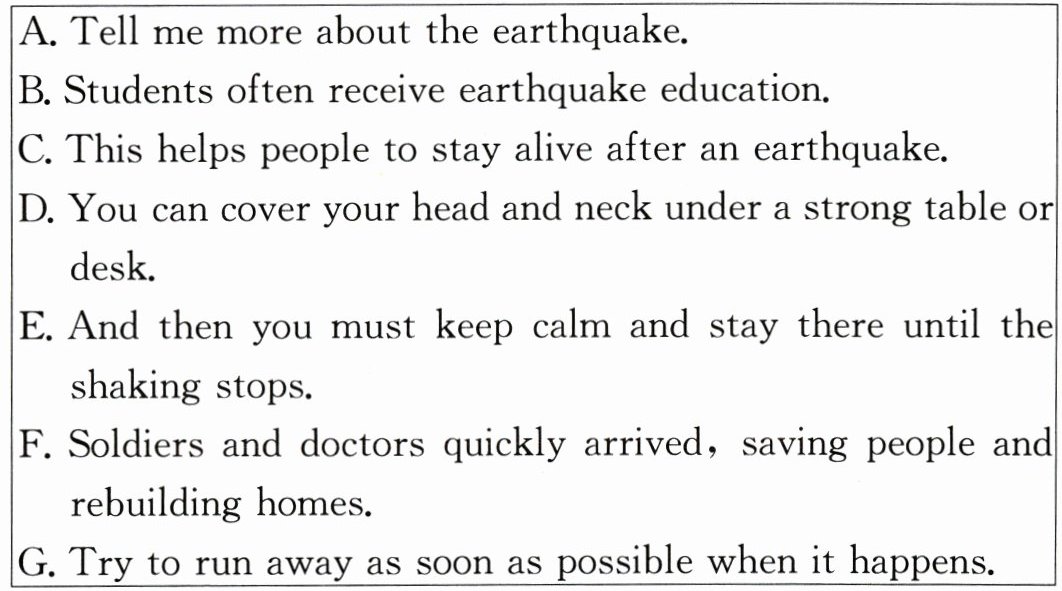
16.
F
17.
D
18.
E
19.
B
20.
C
解析:
【分析】
本题为英语阅读理解七选五题型,需结合上下文语境及逻辑关系选择合适句子。解题思路:先分析每个空缺处前后文的内容,明确空缺处需补充的信息类型(如救援场景、躲避方法、教育相关、工具作用等),再匹配选项,确保句子衔接自然、逻辑通顺。
【解析】
1. 16空:前文描述地震造成的伤亡、无家可归等灾难,后文提到资金援助,F选项“士兵和医生迅速到达,救人并重建家园”符合地震后的救援场景,衔接上下文,故选F。
2. 17空:前文说明地震时不能跳高楼,后文提到无藏身之处时的做法,D选项“你可以把头和脖子藏在坚固的桌子或书桌下”是具体的躲避方法,符合语境,故选D。
3. 18空:前文讲了躲避的动作,E选项“然后你必须保持冷静,待在那里直到震动停止”是躲避时的后续要求,承接上文,故选E。
4. 19空:前文说日本从小教授生存技能,后文提到家庭的生存工具,B选项“学生经常接受地震教育”说明教育的对象,符合上下文逻辑,故选B。
5. 20空:前文提到家庭有生存工具包,C选项“这帮助人们在地震后存活”说明工具包的作用,衔接自然,故选C。
【答案】
16.F 17.D 18.E 19.B 20.C
【知识点】
英语阅读理解、七选五题型、地震安全知识
【点评】
本题考查英语阅读理解七选五,侧重上下文逻辑衔接能力,需结合语境分析句子关联,是常见的英语阅读题型,难度适中。
【难度系数】
0.6