C
[2025南通市海安市期中]① The ocean is home to masses of small floating living things called zooplankton(浮游动物). Some are as tiny as 0.04 inches long, and they spend most of their lives asleep, deep in the ocean. New research has
shone a light on how these little creatures are important for helping to protect the planet against global warming.
② The research, led by scientists from China, the UK and Canada, focused on the Southern Ocean (also known as the Antarctic Ocean). The Southern Ocean covers about one sixteenth of Earth’s total ocean area.
③ The team studied types of zooplankton called copepods, krill(磷虾), and salps. All of these creatures eat tiny plant-like living things called phytoplankton(浮游植物), which live near the sea's surface and absorb(吸收) carbon dioxide (CO₂), a greenhouse gas. Greenhouse gases trap the Sun’s heat in the atmosphere, contributing to climate change. In winter, the zooplankton sink about 1,600 feet below the surface of the ocean. There they slowly breathe out the carbon dioxide from the phytoplankton they have eaten, releasing(释放) it into the water. This process is called the “seasonal migrant pump”. Each year, it transports about 65 million tonnes of carbon to areas far below the ocean’s surface. Because the zooplankton are so deep down, the gas they release takes many years, sometimes even centuries, to rise to the surface and enter Earth's atmosphere.
④ Angus Atkinson, who worked on the study, told BBC News that without the seasonal migrant pump, the levels of carbon dioxide in the atmosphere would be double what they are now.
⑤ Guang Yang, another researcher, said zooplankton are “unsung heroes” of carbon storage. The team hopes the study will encourage scientists to include zooplankton in their calculations of how much carbon is stored around the world. It also highlights the importance of protecting the Southern Ocean, where krill are in danger because of fishing. Environmental activists say people should be careful not to damage krill populations, which are not only a food source for whales, seals, penguins, and seabirds but also help fight climate change.
(
B
)33. What does the phrase “shone a light on” probably mean?
A. wondered B. shown C. imagined D. doubted
(
B
)34. Why is the carbon released by zooplankton slow to enter the atmosphere?
A. It’s taken in by sea animals quickly.
B. It stays deep in the ocean for a long time.
C. It is used by phytoplankton again.
D. It turns into a different gas under the sea.
(
A
)35. Which of the following describes the structure of the passage?
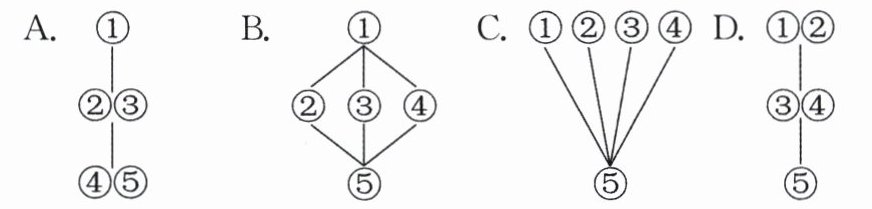
(
D
)36. What's the best title of the passage?
A. New Ways to Store Carbon in the Ocean
B. The Importance of Protecting the Southern Ocean
C. How Krill Are Endangered by Fishing
D. Zooplankton: The Unsung Heroes Fighting Climate Change
D