四、阅读理解
Many people may throw away the pits (果核) inside fruits after eating them, but inheritors of nut carving (核雕继承人) can turn them into artworks.
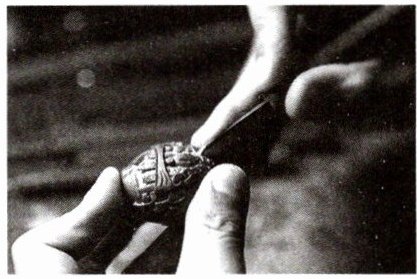
Weifang nut carving goes back to the Qing dynasty. During that time, an old imperial (皇家的) craftsperson Wang Dayan spread the skill to the local people in Shandong Province. Craftspeople at that time often used peach (桃) pits to show off their artistic skills. Because of great carving skills needed, the traditional culture and its colourful artistic theme (主题), Weifang nut carving was listed as a national intangible cultural heritage (国家非物质文化遗产) in 2008.
Tan Wanhai is an inheritor of Weifang nut carving. Tan says he has studied the art of nut carving for 25 years and has made many nut carvings.
However, the craftsperson said that bringing this kind of artwork to life is not easy. "Not like some pits which have a flat surface (平的表面), each peach pit has its own special texture (质地)," Tan says, adding that craftspeople have to study each peach pit to carefully plan out their artwork.
Thanks to their creative design and fresh ideas, Weifang nut carving artworks have been more and more popular in China. More people are learning the art and have even become inheritors to pass down the skill to young people.
"Now, the number of inheritors is about 1,000. But I believe there will be more in the future. More craftspeople now give up (放弃) the tradition of passing down the skill only through the family and open it up to anyone who is interested in learning the skill," says Tan.
(
A
) 1. Weifang nut carving was listed as a national intangible cultural heritage because of
.
① great carving skills
② its colourful artistic theme
③ the traditional culture
④ the popularity around the world
A. ①②③
B. ②③④
C. ①②④
D. ①②③④
(
A
) 2. What does the fourth paragraph mainly tell us?
A. Problems craftspeople have.
B. The cultural value of nut carving.
C. The inheritor and his carving artworks.
D. The information craftspeople have to know.
(
B
) 3. What can we learn from the passage?
A. Weifang nut carving dates from the Ming dynasty.
B. Tan thinks there will be more inheritors of nut carving.
C. Each peach pit has a flat surface and it's easy to carve on it.
D. More craftspeople now give up the tradition of passing down the skill.
(
C
) 4. What could be the best title for the passage?
A. Tan's Works of Nut Carving
B. Amazing Artworks in China
C. Carving Artworks out of Nuts
D. The History of Nut Carving
Exercise 5 of Unit 4 of 7B Pronunciation & Integration (Ⅰ)