二、阅读理解。
Babies don’t learn to talk just from hearing sounds. They are lip (嘴唇) readers too. It happens during the period when a baby's babbling(咿呀声) slowly changes from unclear voices into that first “mama” or “dada”. The babies have to find out how to shape their lips to make the sounds they are hearing, according to developmental psychologist David Lewkowicz of Florida Atlantic University, who led the study.
Clearly it doesn't take them too long to understand the movements that match basic sounds. By their first birthdays, babies start changing back to look at you in the eye again. It offers more clues that quality face-time with babies is very important for speech development more than, say, turning on the latest baby DVD.
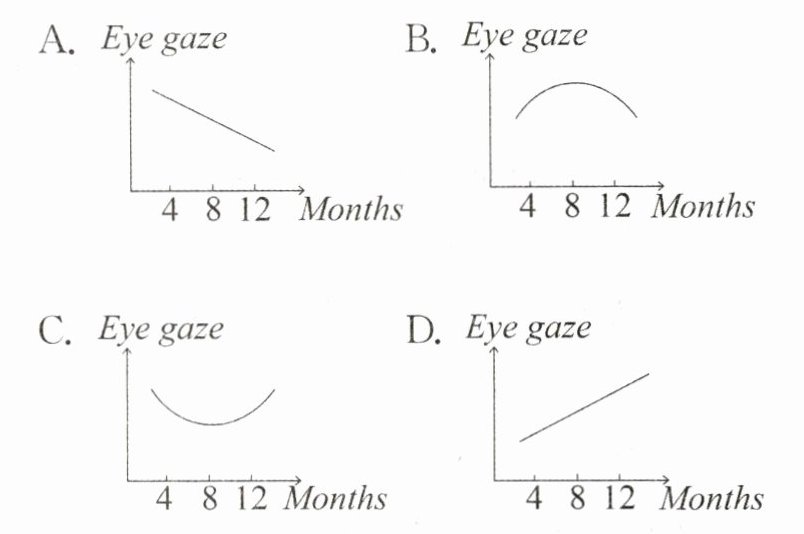
But Lewkowicz went a step further. He and his student Amy Hansen Tift tested nearly 180 babies, groups of them at ages 4, 6, 8, 10 and 12 months. How? They showed videos of a woman speaking in English or French to babies of English speakers. They found that when the speaker used English, the 4-month-old babies gazed (凝视) mostly into her eyes. The 6-month-old babies spent equal amounts(数量) of time looking at the eyes and the mouth. The 8-month-old babies and 10-month-old babies
studied mostly the mouth. At 12 months, attention started changing back towards the speaker's eyes.
But what happened when these babies who are used to English heard French? The 12-month-old babies studied the mouth longer, just like younger babies. They needed the extra information to understand the new sounds. That fits with research into bilingualism(双语) that shows babies' brains adjust themselves to tell the differences between the sounds of their first language and other languages in the first year of life.
The continued lip reading shows the 1-year-old babies clearly still are fit for learning. Babies are so hard to study, says Duke University cognitive scientist Greg Appelbaum, who found the research so fantastic that he wants to know more.
1. According to the first paragraph, babies
A
.
A. might get its voice “mama” by lip reading
B. like to find out how to shape their lips
C. learn to talk just from hearing the sounds
D. communicate by using body language
2. What is necessary in developing babies' speech according to Lewkowicz?
A. Playing baby DVDs nearby.
B. Teaching babies to read English.
C. Speaking with babies face to face.
D. Speaking different languages in front of babies.
3. 新考法 学科融合 Which of the following shows the right change of babies' eye gaze according to the text?
4. What would be the best title of the text?
A. Babies have different methods to talk
B. Babies try lip-reading in learning to talk
C. Babies are suitable to learn two languages
D. Babies can easily accept a foreign language