Ⅴ.阅读理解
In Tongren City, Guizhou [图]
Province, there is a special embroidery
called leaf-vein embroidery(叶脉绣).
This beautiful art is one of the main types of
embroidery in China.
Leaf-vein embroidery has a history from the
Song Dynasty(960-1279). It was first used for
communication among people in different areas.
Making leaf-vein embroidery is not easy. It
takes a lot of steps. First, choosing the right
leaves is important. The leaves from local trees
with harder veins serve as the best materials.
Second, put leaves in clean water for two days
to make them soft. Third, brush the leaves
gently. Then, it takes three to five days to make
them fully dry. Finally, you can create the
patterns on the leaves.
Yang Li, a master of leaf-vein embroidery,
notes that only about 20 people in Tongren have
been able to finish the whole steps by
themselves in the last ten years, so it's
challenging to keep this traditional skill alive.
"I have introduced this art in colleges,
communities and villages, but very few people
wanted to learn
it because it was very difficult,"
Yang said.
In 2011, she started a leaf-vein embroidery
workshop, creating jobs for more than 500
women, including women from villages with
disabilities. "In my lifetime, it's my duty to
improve and pass on leaf-vein embroidery," she
said. After that, she also used social media to
show these traditional skills and got many fans.
"Leaf-vein embroidery is a treasure. I
decide to save and inherit this skill and hope
more young people will return to their
hometown to learn it," Yang said.
1. What was the purpose of leaf-vein embroidery
at first in history?
A. To make clothes beautiful.
B. To communicate with people.
C. To trade with foreign countries.
D. To celebrate festivals.
2.
新考法 创新设问 Which is the RIGHT order
of making leaf-vein embroidery?
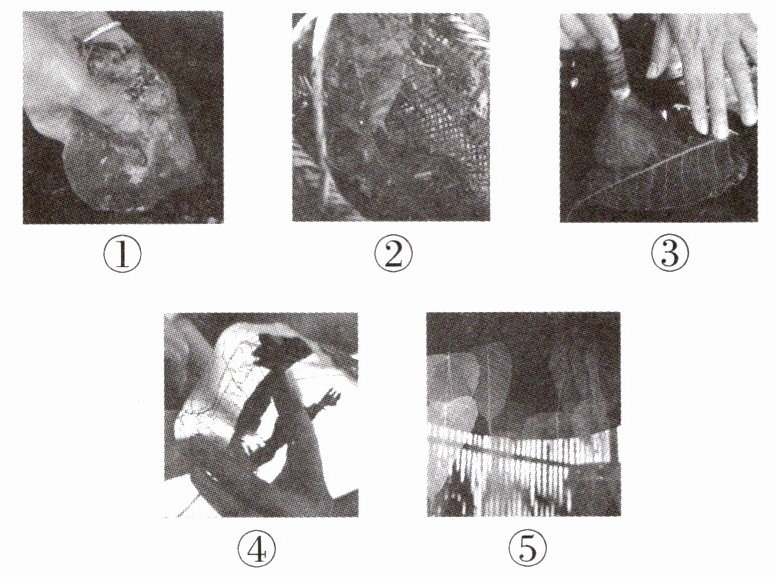
A. ②①③⑤④
B. ②①④③⑤
C. ①③②⑤④
D. ①③②④⑤
3. What does the underlined word "it" in
Paragraph 5 refer to?
A. A workshop.
B. Leaf-vein embroidery.
C. A local tree.
D. A challenge.
4. What is the best title for this passage?
A. The History of Chinese Embroidery
B. How to Make Beautiful Leaf-Vein Embroidery
C. Saving the Art of Leaf-Vein Embroidery
D. Yang Li-A Famous Chinese Artist
Ⅵ.阅读与回答问题
根据短文内容,回答下列问题。
What's the first thing that comes into your
mind when you think of wheat straw(稻草)?
Most people would probably see it as a pile of
waste in a farmer's field. However, Wu Cui, an
intangible cultural inheritor(非遗传承人), can
turn the straw into beautiful artworks.
The earliest straw-weaving(编织) works
were found at Hemudu Cultural Ruins, a
Neolithic cultural site in Zhejiang Province. This
discovery means a lot to traditional Chinese
culture.
The Book of Rites also records that
there were already mats(垫子) made of grass
and professional straw-weaving craftsmen
during the Zhou Dynasty.
Straw weaving is a method of making daily
items or artworks. It was listed as a national
intangible cultural heritage in 2008.
Wu explains the process of straw weaving:
choosing from materials is the first step of a
process that may take several weeks, or even
months to complete. You need to draw the piece
on paper, which requires drawing skills. Next
comes weaving, shaping and preserving(保存)
of the work. Even by finishing that process, it
does not mean that you will always create a good
piece of work, and the hardest part is to make it
lifelike.
In the past, straw items could be found in
almost every family in the countryside, in the
form of straw hats and straw shoes, because
they were practical in everyday life. But with the
development of industry, many of these
products are made in factories. This makes
people gain little money, and there are only
about 100 people joining in the work across the
country.
Wu says to a news reporter that more
craftsmen should work together to make a
difference to the spread of the traditional
culture.
1. Who is an intangible cultural inheritor in the
article?
Wu Cui.
2. When was straw weaving listed as a national
intangible cultural heritage?
In 2008.
3. What comes next after drawing the piece on
paper?
Weaving, shaping and preserving of the work.
4. Why do people make little money?
Because many straw products are made in factories.
5. What can we do to help the art form?
We can learn and promote straw weaving.