Ⅴ.阅读理解
文化意识 文化理解 Since the Zhou Dynasty(1046 BCE—256 BCE), a
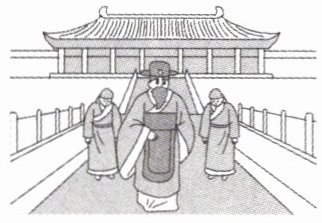
complete etiquette system has been set. Today, many of these rules are not as strict(严格的) as before. However, some are still followed on important occasions(场合) and are thought of as good examples of good manners.
Walking Etiquette
①
In ancient China, while walking with someone with a higher status(地位) or an old person, one should
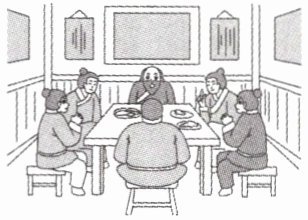
lower one's head, bend down, and walk a little bit behind them. If three people walk together, the eldest or a teacher should be in the middle. One should bow down and walk fast using smaller steps when passing by an elder or a teacher.
Sitting Etiquette and Seating Rules
②
Everyone should be sitting in a proper position (位置) at dining tables. It is based on their titles, ranks, or ages. If someone doesn't know the exact position, they should wait and follow the host's lead. The best seat is the one that faces the east or the door. Hosts usually sit facing the west.
Bow, and Fist-and-Palm Salute(抱拳)
③
Bow, in Chinese Yi Li or Zuo Yi, means having their hands folded(折叠) in front in different ways.
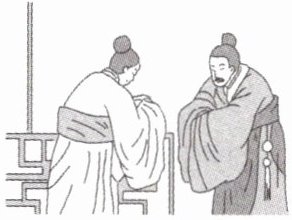
Today, however, the simplest Zuo Yi gesture is good enough, as well as nodding, smiling, and handshaking.
④
The Fist-and-Palm Salute is another type of Yi Li, with the fist's right hand covered by the left hand. It first appeared in the army when people held weapons(武器) while showing respect to others.
So, people always use the left hand to cover the right hand that holds weapons.1. In ancient China, which place should your teacher be when walking with you and your classmate?
A. In the middle.
B. On the left.
C. On the right.
D. At the back.
2. 新考法 补全文章 Where can we put the sentence "The seating order is still widely used in family and business dinners." in the passage?
A. ①
B. ②
C. ③
D. ④
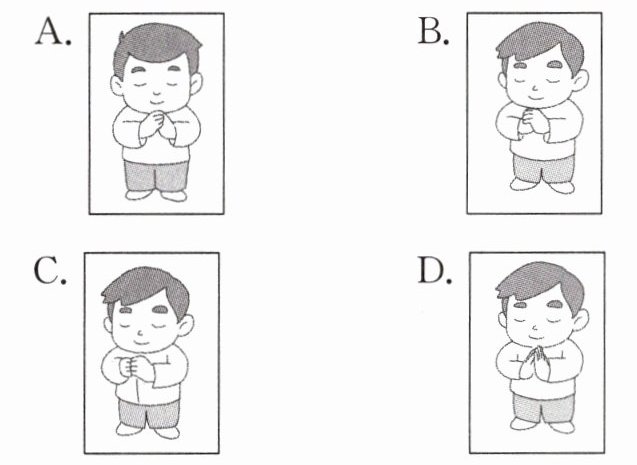
3. 新考法 图示理解 Which of the following pictures CORRECTLY describes "the Fist-and-Palm Salute"?
4. Why is the underlined sentence included in the last paragraph?
A. To give an example.
B. To set the order.
C. To add more information.
D. To show a result.
5. What may the writer talk about in the following paragraph?
A. Another kind of Chinese etiquette.
B. Another kind of Western etiquette.
C. Differences among the three kinds of etiquette.
D. Differences between Chinese and Western etiquette.
Ⅵ. 中考趋势 阅读还原
从方框中选出能填入空白处的最佳选项,选项中有两项多余。
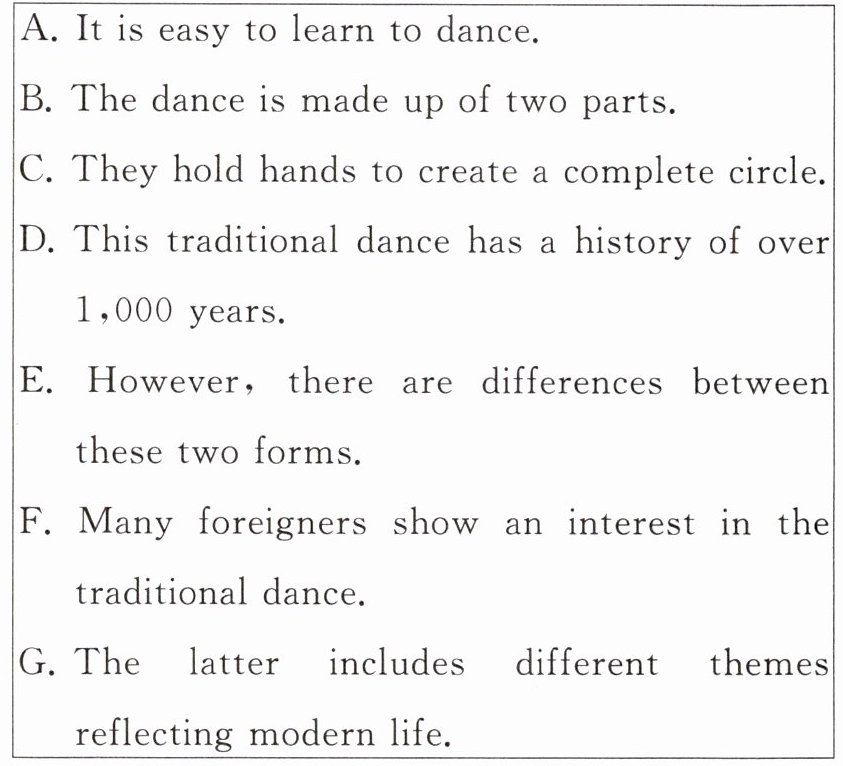
文化意识 文化鉴赏 Guozhuang Dance holds an important place among the Xizang people, being one of their three important folk dances. In the Xizang language, "Guozhuang Dance" means "singing and dancing in a circle".
D
1
And it is also popular in Yunnan Province.
During the dance, men and women form two separate semicircles(半圆形).
C
2
A person is chosen to guide the process, with one man and one woman taking turns asking and answering questions through singing, without music.
B
3
They are a slow-tempo(节奏) dance followed by a fast-tempo dance. Both include a set of basic dance movements. The footwork in the dance is characterized by kinds of turns and other actions, while upper body movements include lifting and waving. People move clockwise(顺时针方向) in a circle, with the size of the circle changing based on the stage performance.
Benzilan Town in Deqin County, along with Jiantang Town and Xiaozhongdian Town in Shangri-La City, is considered to have saved the most traditional forms of Diqing Guozhuang Dance.
E
4
Benzilan Guozhuang Dance focuses on specific dances themed around gatherings, leaving, inviting visitors to stay and more. Shangri-La Guozhuang Dance has developed into two kinds: ancient dance and modern dance. The former has set movements and lyrics, carrying a strong ceremonial nature that is loved by the elderly.
G
5
This traditional dance has been passed down through generations, showing the rich culture and the traditional humanistic spirit of friendship and unity.
1.
2.
3.
4.
5.