1. Thanks to the new education policy(政策), students
can
have more time to do sports and sleep now.
A.must
B.can
C.could
D.should
答案:1. B 解析:Thanks to the new education policy 和 now 说明新政策为学生创造了现实条件,使他们现在“能够”有更多时间运动和睡觉;can 表示现在的能力或客观可能。A 项 must 表示“必须”,强调义务;C 项 could 通常表示过去的能力、假设或较弱的可能;D 项 should 表示“应该”或按理预期,不如 can 直接说明政策带来的现实条件,故选 B。
2. —Sir,
could
I feed the bears at Nantong Forest Safari Park?
—Sorry, I am afraid you
can't
.
A.could; can't
B.can; needn't
C.need; can't
D.must; couldn't
答案:2. A 解析:根据问句中的 Sir 和答语 Sorry 可知,说话者礼貌地请求许可,对方表示不允许;could 可用于委婉请求,can't 表示不允许。needn't 表示不必,不能表达此处的拒绝,故选 A。
3. —Li Hua, the view on the top of Wolf Hill is so beautiful! Look! Is that a fishing boat over there? —No, it
can't
be because fishing is not allowed. We must protect the Yangtze River now.
A.can
B.can't
C.must
D.mustn't
答案:3. B 解析:答语 No 和“禁止捕鱼”表明说话者认为那不可能是渔船,can't be 表示有依据的否定推测。A 项 can be 表示可能,与 No 冲突;C 项 must be 表示肯定推测;D 项 mustn't be 表示“禁止成为”,不是对身份的否定推测,故选 B。
4. We never know what
might
happen in the future, but we can prepare for the worst and hope for the best.
A.must
B.might
C.shall
D.should
答案:4. B 解析:“in the future”(未来)表示不确定,“might”(可能)符合语境,“must”表“必须”,“shall”表“将要”(第一人称),“should”表“应该”,故选 B。
5. —My father seldom sleeps well at night.
—That's bad. He had better
not drink
much coffee.
A.drink
B.not to drink
C.not drink
D.drinking
答案:5. C 解析:“had better not do sth”为固定搭配(最好不做某事),故选 C。
Ⅱ.用正确的情态动词填空
1. I left my wallet at home.
Could/Can/Would/Will
you please lend me some money?
2. Don't throw away things such as old clothes and books. You
can/should/could
collect them and give them away.
3. Don't take photos at the zoo. You
may/might/can/could
scare the animals.
4. I
can't
stand watching soap operas because they are too boring.
5. Anna
couldn't
ice-skate before, so she didn't like winter.
答案:1. Could/Can/Would/Will 解析:前句说明说话者把钱包落在家里,后句是在礼貌地请求对方借钱;Could you please do sth? 是委婉请求的常用句型,Can、Would 或 Will 也都可用于提出这一请求,语气有所不同,故填 Could/Can/Would/Will。
2. can/should/could 解析:前句劝人不要扔掉旧衣服和书,后句提出一种可行的处理方式;can 表示“可以”,说明可以收集这些物品并捐出,should 可表示“应该”,could 可表示委婉建议,在现有语境中也都可以成立,故填 can/should/could。
3. may/might/can/could 解析:拍照可能惊吓动物,空格需要表示不确定的可能性;may 意为“可能”,后接动词原形 scare,might、could 以及表示一般可能性的 can 也可成立,故填 may/might/can/could。
4. can't 解析:can't stand doing sth 是固定搭配,意为“不能忍受做某事”;后文 because they are too boring 说明说话者无法忍受看肥皂剧,句子叙述现在的一般感受,故填 can't。
5. couldn't 解析:before 和 so she didn't like winter 共同构成过去语境,且 ice-skate 表示一种技能;couldn't 表示过去“不具备某种能力”,说明 Anna 以前不会滑冰,故填 couldn't。
1. —Susan, what did you do yesterday?
—I
B
the history museum with my friends.
A.visit
B.visited
C.am visiting
D.will visit
答案:1. B 解析:根据“yesterday”(昨天)可知时态为一般过去时,“visit”的过去式为“visited”,故选 B。
2. —Jim, what's your plan for this weekend?
—I
D
a film with my dad.
A.am watching
B.watch
C.watched
D.am going to watch
答案:2. D 解析:根据“this weekend”(这个周末)可知时态为一般将来时,“be going to watch”表示计划做某事,故选 D。
3. Unluckily, my younger sister
A
off a bike and
A
her leg.
A.fell; hurt
B.felt; hurted
C.felt; hurt
D.falled; hurted
答案:3. A 解析:“fall off”(摔倒),fall 的过去式为“fell”,“hurt”(受伤)的过去式为“hurt”,“felt”为“feel”的过去式(感觉),不符合语境,故选 A。
4. Tom and his friends visited Hongze Lake Wetland
C
.
A.next week
B.every Sunday
C.the other day
D.tomorrow
答案:4. C 解析:“visited”为一般过去时,“the other day”(前几天)用于过去时,“next week/tomorrow”用于将来时,“every Sunday”用于一般现在时,故选 C。
5. —What are you going to do next weekend?
—There
A
a basketball match next Sunday. I want to watch it.
A.will be
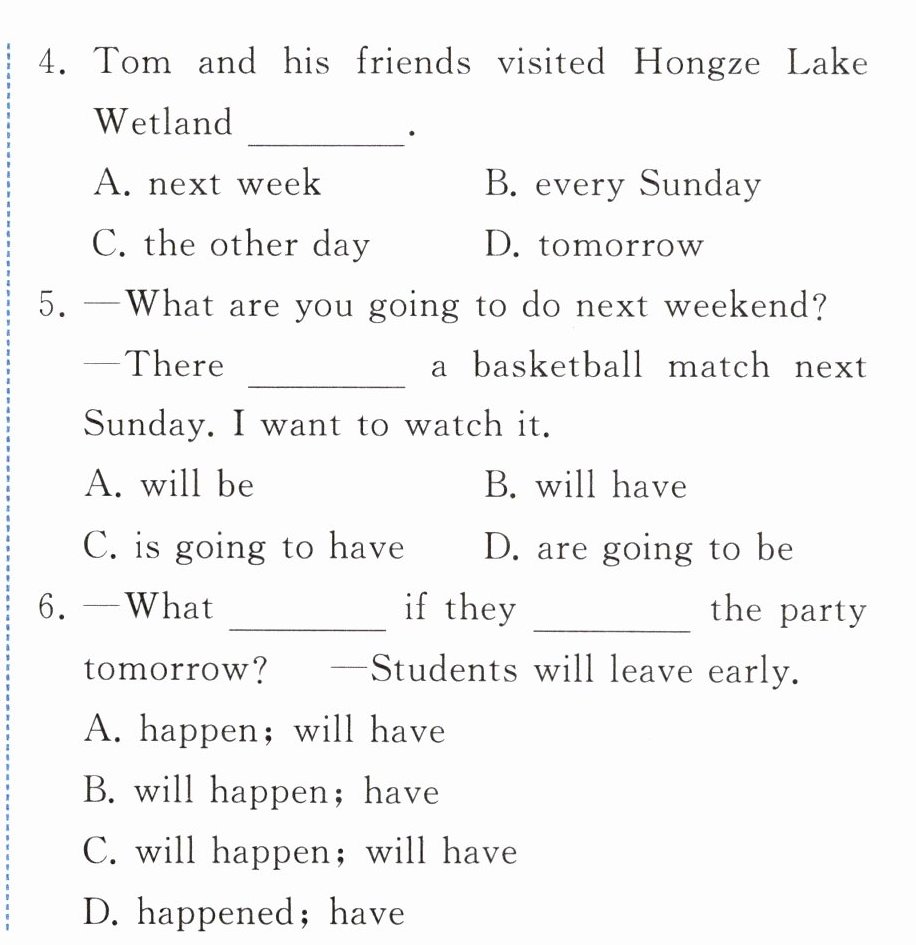
B.will have
C.is going to have
D.are going to be
答案:5. A 解析:“next Sunday”(下周日)表示将来,“there be”句型的将来时为“there will be”或“there is/are going to be”,“a basketball match”为单数,排除 D 项;“there have”为错误表达,故选 A。
6. —What
B
if they
B
the party tomorrow? —Students will leave early.
A.happen; will have
B.will happen; have
C.will happen; will have
D.happened; have
答案:6. B 解析:“if”引导的条件状语从句,遵循“主将从现”,主句用“will happen”,从句用“have”,故选 B。