1. Don't worry. Only
part
of the food market was damaged in the storm. The people living around here can still go on with their
everyday
lives without any problems.
A.part; everyday
B.parts; everyday
C.part; every day
D.a part; every day
答案:1. A 解析:第一个空填 part,part of the food market 表示“食品市场的一部分”,与单数谓语 was 一致;B 项的主语 parts为复数,谓语应使用 were。第二个空修饰名词 lives,表示“日常的生活”,应用形容词 everyday;every day 是意为“每天”的副词性短语,不能直接修饰 lives,因此排除 C、D。故选 A。
易错提醒 形容词 everyday(日常的)后接名词,副词短语 every day(每天)作状语,修饰谓语动词或整个句子。
2. We should not reach for what is beyond our reach. What we need to do is improving our
basic
skills first.
A.short
B.basic
C.serious
D.excellent
答案:2. B 解析:A“short”意为“短的”;B“basic”意为“基础的”;C“serious”意为“严肃的”;D“excellent”意为“优秀的”。根据“improving our ... skills first”(首先提高……技能)可知,选 B。
3. The ox(公牛)is a symbol of hard work in Chinese culture. The
spirit
of the ox is mentioned in a poem by Lu Xun: "Head bowed, like a willing ox who serves people."
A.sign
B.interest
C.miss
D.spirit
答案:3. D 解析:根据首句“公牛在中国文化中是勤奋工作的象征”和鲁迅诗句中俯首为民的形象可知,此处强调公牛所代表的勤劳、奉献精神;spirit 意为“精神”,符合语境。sign 意为“标志;迹象”,interest 意为“兴趣”,miss 意为“错过;思念”,均不符合句意,故选 D。
4. —That's all for today. Do you have anything to
add
? —Nothing more. We all agreed with what you said.
A.fill
B.make
C.add
D.mix
答案:4. C 解析:A“fill”意为“填满”;B“make”意为“制作”;C“add”意为“补充”;D“mix”意为“混合”。根据“anything to ...?”(有什么要……的吗?)可知,选 C。
5. —What are they busy doing over there? They should have a rest now. —They are
working on
a new project. They need to make the final plan as soon as possible.
A.getting on
B.working on
C.knocking on
D.taking on
答案:5. B 解析:A“getting on”意为“上车”;B“working on”意为“从事”;C“knocking on”意为“敲门”;D“taking on”意为“承担”。根据“a new project”(新项目)可知,选 B。
6. Which word can we put in the vocabulary tree on the right?
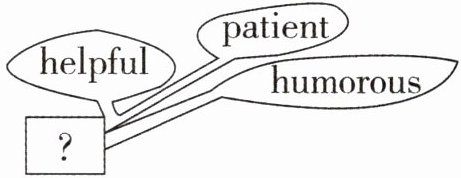
A.jobs
B.qualities
C.looks
D.feelings
答案: B 解析:“patient”(有耐心的)、“helpful”(有帮助的)、“humorous”(幽默的)均属于人的品质,“qualities”意为“品质”,故选 B。
7. —Let's run to the bus station
quickly
, or we may miss the early bus. —You're right. We have little time. Let's hurry.
A.slowly
B.largely
C.easily
D.quickly
答案:7. D 解析:A“slowly”意为“慢慢地”;B“largely”意为“主要地”;C“easily”意为“容易地”;D“quickly”意为“快速地”。根据“or we may miss the early bus”(否则会错过早班车)可知,选 D。
8. The kite is made
of
silk and made
by
hand. So it's very expensive.
A.of; from
B.from; by
C.of; by
D.from; from
答案:8. C 解析:“be made of”表示“由……制成”,成品能看出原材料(丝绸做的风筝能看出原材料);“be made by hand”意为“手工制作”,固定搭配,故选 C。
9.(淮安中考)—Oh! I forgot to bring
my
ruler.
—Don't worry. I can share mine with you.
A.I
B.me
C.my
D.mine
答案:9. C 解析:此处用形容词性物主代词“my”修饰“ruler”(我的尺子),故选 C。
10. If you want to stress the time in the sentence
" Sandy paints pictures on Saturday afternoons", which word(s) should you read more loudly?
A.Sandy
B.paints
C.pictures
D.Saturday afternoons
答案: D 解析:题干明确要求强调时间,因此应重读句中的时间状语 on Saturday afternoons,选项中对应的核心部分是 Saturday afternoons。Sandy 强调人物,paints 强调动作,pictures 强调对象,均不符合题目设定的对比焦点,故选 D。
Ⅱ.完形填空(每小题1分,满分15分)
新素材 峨眉派传人 In recent years, Lingyun, a woman from Ya'an, Sichuan, has amazed the world with her martial arts(武术$) skills \underline{\quad1\quad} her online videos.$
$Lingyun began \underline{\quad2\quad} martial arts at age 4. At age 10, she studied at the Emei Sect($派$). Now, as a martial arts master, Lingyun loves to show different skills at home and \underline{\quad3\quad}. In her videos, Lingyun, sometimes wearing red clothes, performs her martial arts in some of the most beautiful \underline{\quad4\quad} places around Jiuzhaigou. In a sea of bamboo in southern Sichuan, she \underline{\quad5\quad} a swordsman($剑客$). \underline{\quad6\quad} China, Lingyun also tries to perform Emei Martial Arts in other parts of the world. People can see Lingyun do martial arts in front of the Eiffel Tower \underline{\quad7\quad} the Louvre in Paris, France.$
$Lingyun likes to include everyday things in her \underline{\quad8\quad}. In February 2020, Lingyun became an internet hit, \underline{\quad9\quad} a video of her in pajamas($睡衣) performing martial arts with a sword—right after she took the rubbish to a bin(垃圾箱$) in her \underline{\quad10\quad}. Performances like this add a \underline{\quad11\quad} to her videos and have helped her reach more people. She even works \underline{\quad12\quad} to spread Emei Martial Arts creatively, by including modern things like games in her videos.$
$However, Lingyun doesn't \underline{\quad13\quad} at just performing Emei Martial Arts. She also tries to include \underline{\quad14\quad} Chinese calligraphy and painting, tea and other things of Chinese culture in her videos.$
$Lingyun feels \underline{\quad15\quad} that millions of people like her videos. She hopes someday she can bring Emei Martial Arts to a bigger stage($舞台) and introduce more people to traditional Chinese culture.
1. A. as
B. through
C. to
D. about
2. A. learning
B. having
C. keeping
D. making
3. A. outdoors
B. indoors
C. outside
D. abroad
4. A. national
B. cultural
C. natural
D. formal
5. A. senses
B. becomes
C. views
D. attracts
6. A. Besides
B. Without
C. Around
D. Through
7. A. or
B. but
C. so
D. because
8. A. videos
B. dramas
C. articles
D. poems
9. A. instead of
B. according to
C. next to
D. thanks to
10. A. town
B. motherland
C. countryside
D. neighbourhood
11. A. style
B. pity
C. expression
D. symbol
12. A. hard
B. badly
C. difficultly
D. strictly
13. A. study
B. stop
C. strike
D. look
14. A. moving
B. painful
C. traditional
D. golden
15. A. worried
B. down
C. lucky
D. angry
答案:Ⅱ. 1.B 2.A 3.D 4.C 5.B 6.A 7.A 8.A 9.D 10.D 11.A 12.A 13.B 14.C 15.C
【语篇解读】本文是一篇记叙文,主要讲述峨眉武术传承人凌云通过网络视频创新展示武术并传播中国传统文化的经历。
1. B 解析:句意为“凌云通过网络视频用武术技能惊艳世界”。through 表示“通过;借助”,强调传播渠道或方式;as 意为“作为”,to 和 about 均不能表达借助视频这一方式,故选 B。
2. A 解析:begin doing sth 意为“开始做某事”,begin learning martial arts 表示“开始学习武术”。having、keeping 和 making 均不能与 martial arts 构成符合语境的搭配,故选 A。
3. D 解析:at home and abroad 是固定搭配,意为“在国内外”。后文先写她在九寨沟、川南竹海拍摄,又写她在法国巴黎表演,正好与“国内外”相呼应,故选 D。
4. C 解析:九寨沟和川南竹海以自然风光著称,natural places 表示“自然景观地”,符合下文的场景举例。national 意为“国家的”,formal 意为“正式的”;cultural 虽可表示“文化的”,但下文的竹海线索明确偏向自然景观,故选 C。
5. B 解析:在川南的一片竹海中,她通过装束和武术表演“化身为”一名剑客;becomes 意为“变成;成为”,主语 she 为第三人称单数,形式和语意均符合,故选 B。
6. A 解析:空后写她还尝试在世界其他地区展示峨眉武术,Besides China 意为“除了中国以外(还有)”,与 also 和 other parts of the world 形成递进关系。Without、Around 和 Through 均不能表达“除中国之外”的范围补充,故选 A。
7. A 解析:空格连接 the Eiffel Tower 与 the Louvre 两个地点,现有选项中只有并列连词 or 能够构成“在埃菲尔铁塔或卢浮宫前”的表达;but 表示转折,so 表示结果,because 表示原因,均不合句法和语意,故选 A。
8. A 解析:本段一直介绍凌云网络视频的内容和风格,everyday things 被加入的是她的 videos;后文“a video of her in pajamas”也形成词汇复现。dramas、articles 和 poems 均与语篇主线不符,故选 A。
9. D 解析:睡衣舞剑视频是凌云走红网络的原因,thanks to 意为“多亏;由于”,可引出积极结果的原因。instead of 表示“而不是”,according to 表示“根据”,next to 表示“紧邻”,均不合逻辑,故选 D。
10. D 解析:把垃圾拿到附近垃圾箱是发生在居住区内的日常行为,neighbourhood 意为“街区;居住区”,最符合具体生活场景,故选 D。
11. A 解析:睡衣舞剑、倒完垃圾后表演等生活化设计给她的视频增添了一种独特风格;style 意为“风格”,是四项中唯一符合语意且能与冠词 a 搭配的名词。expression 前通常应使用 an,pity 和 symbol 均不合语境,故选 A。
12. A 解析:work hard 是固定搭配,意为“努力工作”;hard 在此是副词,修饰 works,说明她努力以创新方式传播峨眉武术。badly、difficultly 和 strictly 均不符合语意或搭配,故选 A。
13. B 解析:stop at doing sth 意为“止步于或局限于做某事”。后文说明她还把书法、绘画和茶文化等元素加入视频,可知她并不止步于表演峨眉武术,故选 B。
14. C 解析:书法、绘画、茶等都是中国传统文化元素,traditional 意为“传统的”,能够概括这些代代相传的内容。moving 意为“感人的”,golden 意为“金色的”,故选 C。
15. C 解析:数百万人喜欢她的视频是积极结果,因此凌云感到自己很幸运;lucky 意为“幸运的”,符合人物情感。worried、down 和 angry 均为负面情绪,与语境相反,故选 C。