C 核心素养 中华优秀传统文化
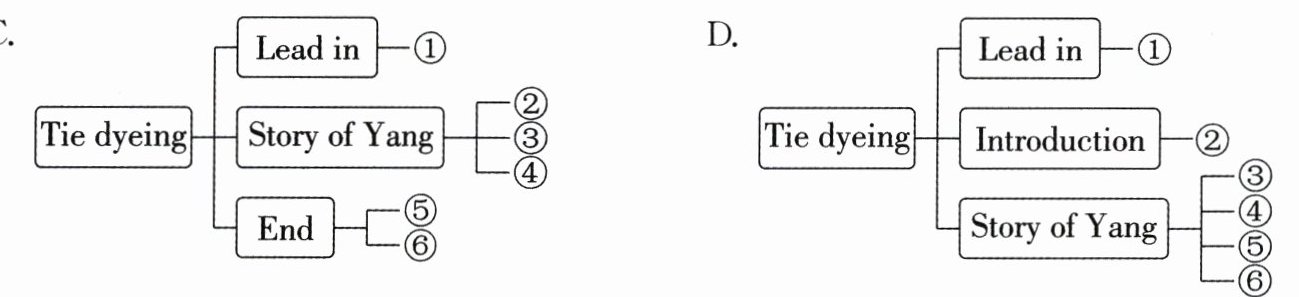
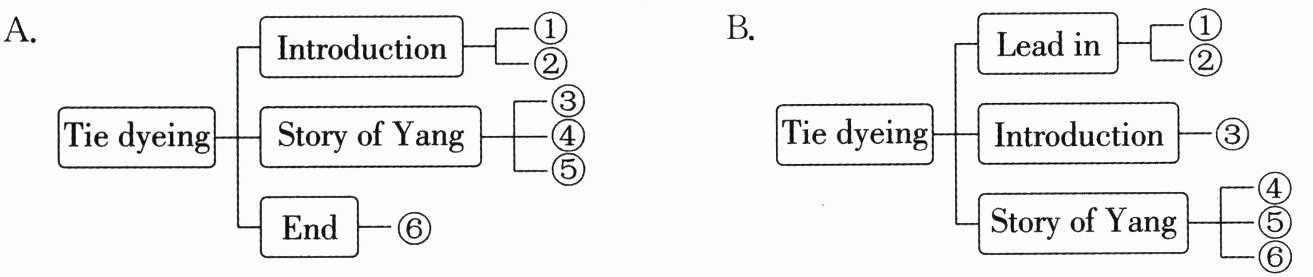
① Do you wear clothes with colourful patterns? People usually use machines to make these patterns. But how did ancient people make them?
② Ancient people used tie dyeing(扎染). Tie dyeing is a very old way of dyeing clothes in China. It is popular in Yunnan. People first put cloth(布料) into the blue dye(染料). Some parts of the cloth become blue, but other parts have a lighter colour. When you open the cloth, you'll see beautiful patterns.
③ In 2006, tie dyeing was listed as China's national intangible cultural heritage. Anning in Yunnan is famous for tie dyeing.
④ Yang Cheng learned the skill from his mother in the 1980s. Yang got the old skills. At the same time, he studied tie dyeing in other countries, such as Japan, India and France. It once took Yang about two years to make two dresses! He used many skills of Anning tie dyeing. Some patterns on the dresses are traditional, while others are modern. He added elements of Dianchi Lake and eight popular flowers in Yunnan. “I want to put all the beautiful things into tie dyeing works,” Yang said.
⑤ Now Yang teaches tie dyeing in schools, communities and companies. More than 100,000 people have learned from him.
⑥ Some might worry that tie dyeing will be replaced by machines. But Yang said, “Machines can't take the place of our creative hands.”
(
)33. What can tie dyeing help people do?
A. Make cloth. B. Grow popular flowers.
C. Make colourful patterns. D. Practise skills.
(
)34. According to the passage, which of the following is true?
A. Tie dyeing is going to die out.
B. We can find tie dyeing only in China.
C. Yang Cheng uses not only traditional patterns but also modern ones.
D. Yang Cheng only passes down the skill to his families.
(
)35. The last paragraph shows that tie dyeing is
.
A. not so useful as before B. popular with young people
C. hard to see in other places D. still meaningful to us
(
)36. Which of the following best shows the structure of this passage?
A.
C.