C 跨学科 语文
① Poems from the Tang and Song dynasties, operas from the Yuan Dynasty, and novels from the Ming and Qing dynasties are very famous in China's history. Today, I'd like to recommend a famous poet and writer in the Mid-Tang Dynasty, Liu Yuxi(772-842).
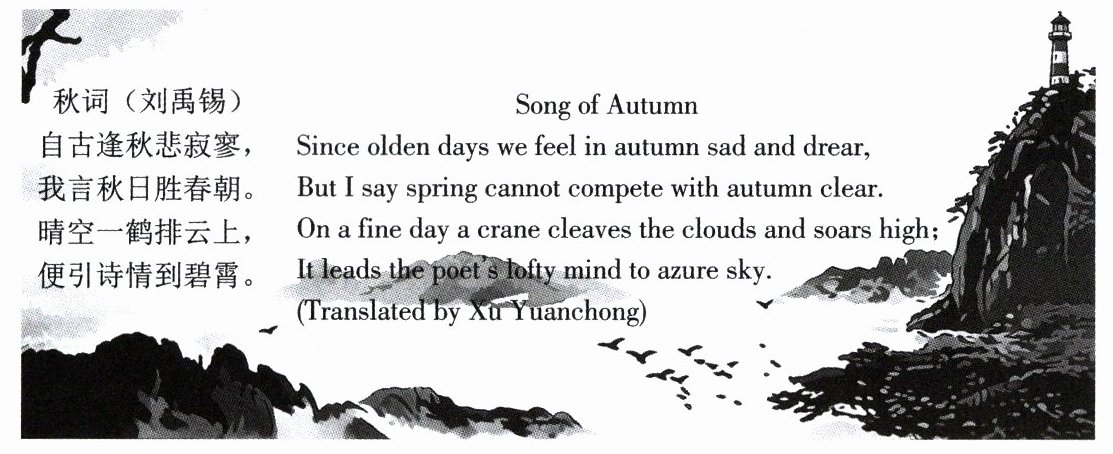
② “Song of Autumn” is one of his poems. Just as shown in the first line of the poem, most ancient poets liked to describe autumn as a sad time, but in this poem the season appears differently. In Liu's eyes, autumn, full of life and hope, is even better than the spring morning. He describes the bright scene of a crane riding the clouds and flying into the blue sky.
③ With his poems expressing personal feelings, as well as the daily life of common people, Liu wrote poems with beautiful music-like words. You may feel it in this poem. Though translated thoughtfully by the experienced translator Xu Yuanchong, the English version still doesn't read as beautifully as the Chinese version. I personally think that English is sometimes not so powerful as Chinese.
④ Here is another example. In Liu's essay “Ode to the Humble Dwelling(《陋室铭》)”, with less than 100 words, he shows a lively picture of his humble cell. However, it also shows how he was pleased with the poor and simple life. People may find it strange that one can feel happy living in such a humble cell. Learning from his famous sentence “This is a humble house, but my virtue makes it fragrant(斯是陋室,惟吾德馨)”, I think to be a respectable man is more important than to live in a big house, to wear beautiful clothes, to enjoy delicious food, and even to gain knowledge.
(
A
)33. In which dynasty was the poem “Song of Autumn” written?
A. Tang. B. Song. C. Yuan. D. Ming.
(
D
)34. According to Paragraph 2, which best describes Liu Yuxi?
A. Strange. B. Honest. C. Lonely. D. Hopeful.
(
B
)35. Influenced by Liu Yuxi, which of the following does the writer think is the most important?
A. To gain knowledge.
B. To have many good qualities.
C. To live a poor and simple life.
D. To live in a comfortable house.
(
A
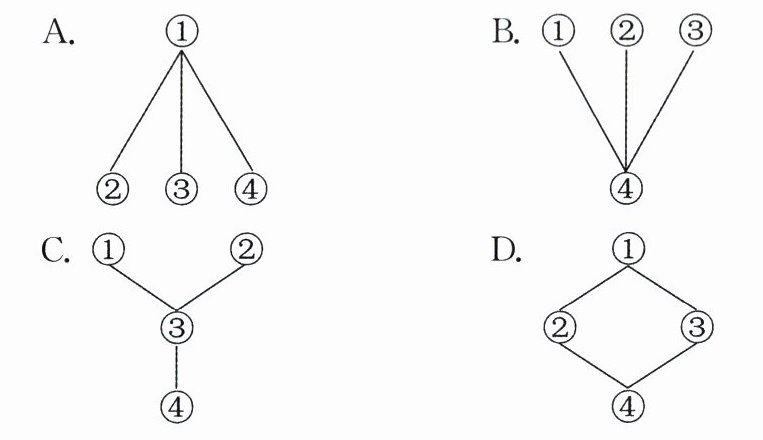
)36. What's the structure of the passage?
D