B
新素材 社会百科 People believe that every word has its correct meaning(s). When we are not sure, we usually check online, or turn to our teachers or dictionaries. But do you know how dictionaries were made in the past?
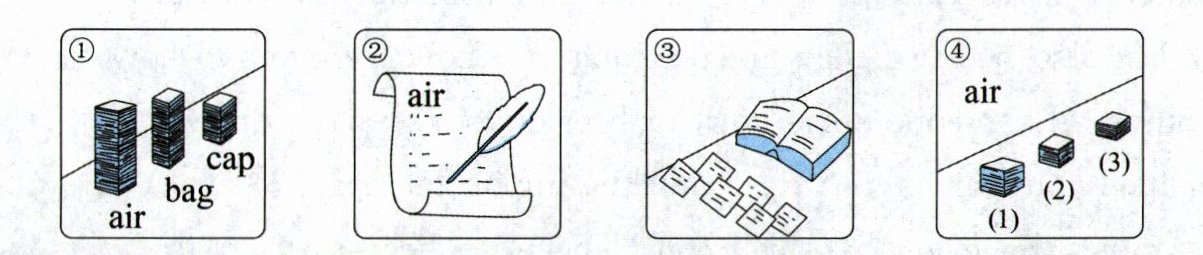
Dictionary writers first read the important books of the period or the subject that the dictionary was about. As they read, they copied necessary information on cards: interesting words, common words—both in their daily uses and unusual uses, and also the sentences where they were used. That is to say, the words, along with the uses of each word, were collected. For a really big dictionary, millions of such cards were collected. This task could last for years. As the cards were collected, they were put in alphabetical order(A—Z). When this was done, there would be several hundred cards for each single word.
Then, to define(定义) a word, the dictionary writer placed its hundreds of cards before him. He read the cards closely, threw away some, read the rest again, and divided up the cards according to what he thought were the common uses of the word. Finally, he wrote the definitions, following the hard-and-fast rule: each definition must come from an example on a certain card in front of him.
So, the writing of a dictionary was not a task of inventing meanings of words, but a task of recording their meanings. The writer of a dictionary was a historian, not a lawmaker.
As time develops, the way of producing dictionaries has greatly changed. Nowadays, we can use online dictionaries too. When choosing our words in speaking or writing, we can be guided by the dictionary. However, we cannot be controlled by it, because new situations, new experiences, new inventions, and new feelings, are always pushing us to give new uses to old words.
(
B
)4. Why did dictionary writers read important books?
A. To know more about the period.
B. To collect words and their uses.
C. To understand different subjects.
D. To learn to use interesting words.
(
D
)5. 新考法 看图排序 Which shows the correct steps of how dictionaries were made in the past?
A. ①③④②
B. ①②④③
C. ③④②①
D. ③①④②
(
C
)6. What can we learn from the passage about dictionary writing in the past?
A. It should be done by historians.
B. It was just a task of inventing.
C. It was long-time hard work.
D. It had to use the law-making rules.
(
A
)7. What does the writer advise us to do when we choose words in communication?
A. Be open to the new uses of words.
B. Follow the dictionary strictly.
C. Use online dictionaries instead.
D. Try to create new words.
解析:
【分析】
这是一篇介绍传统词典编纂流程的科普说明文,解题时首先要明确每道题的提问指向,带着题干关键词回原文定位对应段落,逐一比对选项排除错误表述:第4、6、7题属于细节理解题,直接匹配原文内容即可得出答案;第5题是图文排序题,需要先从原文梳理出词典编纂的完整先后步骤,再逐一对应四幅图的场景含义,匹配出正确顺序即可。
【解析】
4. 定位原文第二段内容“As they read, they copied necessary information on cards: interesting words, common words—both in their daily uses and unusual uses, and also the sentences where they were used. That is to say, the words, along with the uses of each word, were collected.”,可知词典编纂者阅读相关重要书籍的核心目的是收集单词以及对应的不同用法,A、C选项都不是该行为的核心目的,D选项表述过于片面,仅提到了有趣的单词,不符合原文描述,因此选B。
5. 梳理原文第二、三段的传统词典编纂流程:① 第一步:编纂者阅读对应领域的重要书籍,将需要的单词、用法、例句等信息抄录在卡片上,对应图③摊开的书本和散落的记录卡片的场景;② 第二步:将收集完成的所有卡片按照A-Z的字母顺序排列归类,对应图①按air、bag、cap首字母分类堆叠的卡片场景;③ 第三步:筛选卡片,丢弃无用内容后将剩余卡片按词义分类整理,对应图④按(1)(2)(3)编号分类堆叠的卡片场景;④ 第四步:对照整理好的卡片,编写每个单词的释义,对应图②在文稿上书写单词释义的场景。因此正确顺序为③①④②,对应选项D。
6. 定位原文第二段“For a really big dictionary, millions of such cards were collected. This task could last for years.”,可知过去编纂大型词典需要收集数百万张卡片,耗时数年,是长期且艰巨的工作。A选项错误,原文仅说明词典编写者是词义的记录者,属性类似历史学家,并非要求必须由历史学家完成编纂;B选项错误,原文明确指出词典编写不是创造词义的工作;D选项错误,原文提到的硬性规则是所有释义必须来自卡片上的实例,并非立法相关规则,因此选C。
7. 定位原文最后一段“we cannot be controlled by it, because new situations, new experiences, new inventions, and new feelings, are always pushing us to give new uses to old words.”,可知作者建议我们不要被词典的既有定义束缚,要接纳单词随时代发展产生的新用法。B选项“严格遵循词典”和原文表述相悖,C选项“完全使用在线词典”原文未提及,D选项“尝试创造新词”不符合原文内容,因此选A。
【答案】
4.B 5.D 6.C 7.A
【知识点】
阅读理解细节定位,事件逻辑排序,说明文内容理解
【点评】
本题属于科普类阅读理解,融入了图文排序的创新考法,既考查学生快速定位原文信息、筛选比对细节的基础阅读能力,也要求学生能梳理事件的先后逻辑,将文字描述和图示场景准确对应,同时也向学生科普了传统词典的编纂常识,传递了语言随社会发展动态变化的理念。
【难度系数】
0.6