二、一曲流行音乐与京剧戏腔碰撞的佳作在音乐节上点燃全场,将氛围推向最高潮。京剧是我国传统文化的瑰宝,下面让我们一起来了解它的起源、艺术特点等。根据短文内容,补全表格信息。
Chinese operas are traditional dramas including literature, music, dance, martial arts(武术), and acrobatics(杂技). There are many local Chinese operas and some enjoy great popularity. Among them, Beijing opera is the most famous type of opera in China.
In the beginning, Beijing did not have its own style of opera. According to the legend, Emperor Qianlong(1711—1799) had seen and enjoyed some Huiban performances when he toured Yangzhou, Jiangsu Province. The word "ban" means an opera company, while the word "hui" probably refers to Anhui Province. There were many famous Huiban groups performing in Yangzhou, and they performed various opera styles, including erhuang and kunqu. Since Qianlong had enjoyed Huiban performances so much, four Huiban groups were invited to perform in Beijing for Qianlong's 80th birthday celebration in 1790, which proved successful. From then on, they lived in the capital, mostly performing for the palace, and then later also performing for the public. Over the years, Beijing opera developed and changed, borrowing parts of other opera styles, particularly Kunqu opera, which had been popular in the palace before 1790. Over time, it developed its own artistic style and a complete performing system(表演体系). It is now considered as the crown of Chinese opera.
Singing, recitation, acting, and acrobatic fighting(唱、念、做、打) are the four artistic means and the four basic skills of Beijing opera. Footwork(脚步动作) and other movements express the actions such as riding a horse, rowing a boat, opening a door, going upstairs, climbing a hill, or travelling. Beijing opera is a number of stylized(非写实的) actions to tell a story or present different characters and their feelings of happiness, anger, sorrow, surprise, fear and sadness.
There are many famous masters who are good at performing Beijing opera. Among them, the four famous Dans—Mei Lanfang, Cheng Yanqiu, Shang Xiaoyun and Xun Huisheng are the most well-known. They are experts in performing the role of Dan and each has its own artistic feature. Their wonderful performances are still praised by many people.
Beijing opera is a prized form of theatre in China. It continues to bring to life many ancient stories and heroes, which enchants(使陶醉) many Chinese people and foreigners with its artistic charm. As the most influential type of opera in China, Beijing opera is an important form of expression of the traditional culture of the Chinese nation. It is sure that it is really the treasure of Chinese culture.
| Beijing opera | |
| --- | --- |
| Introduction | As the most famous national opera, Beijing opera is famous across the country and becomes popular among people. |
|$ The \underline{ 1 } of Beijing opera $|$ • Huiban performances caught Emperor Qianlong's great \underline{ 2 } when he toured Yangzhou.$
$• In 1790, Huiban groups were invited to Beijing in order to celebrate Qianlong's 80th birthday, which turned out a \underline{ 3 }.$
• Later, Huiban groups made their homes in Beijing and gave performances to more people.
• Other opera styles were also
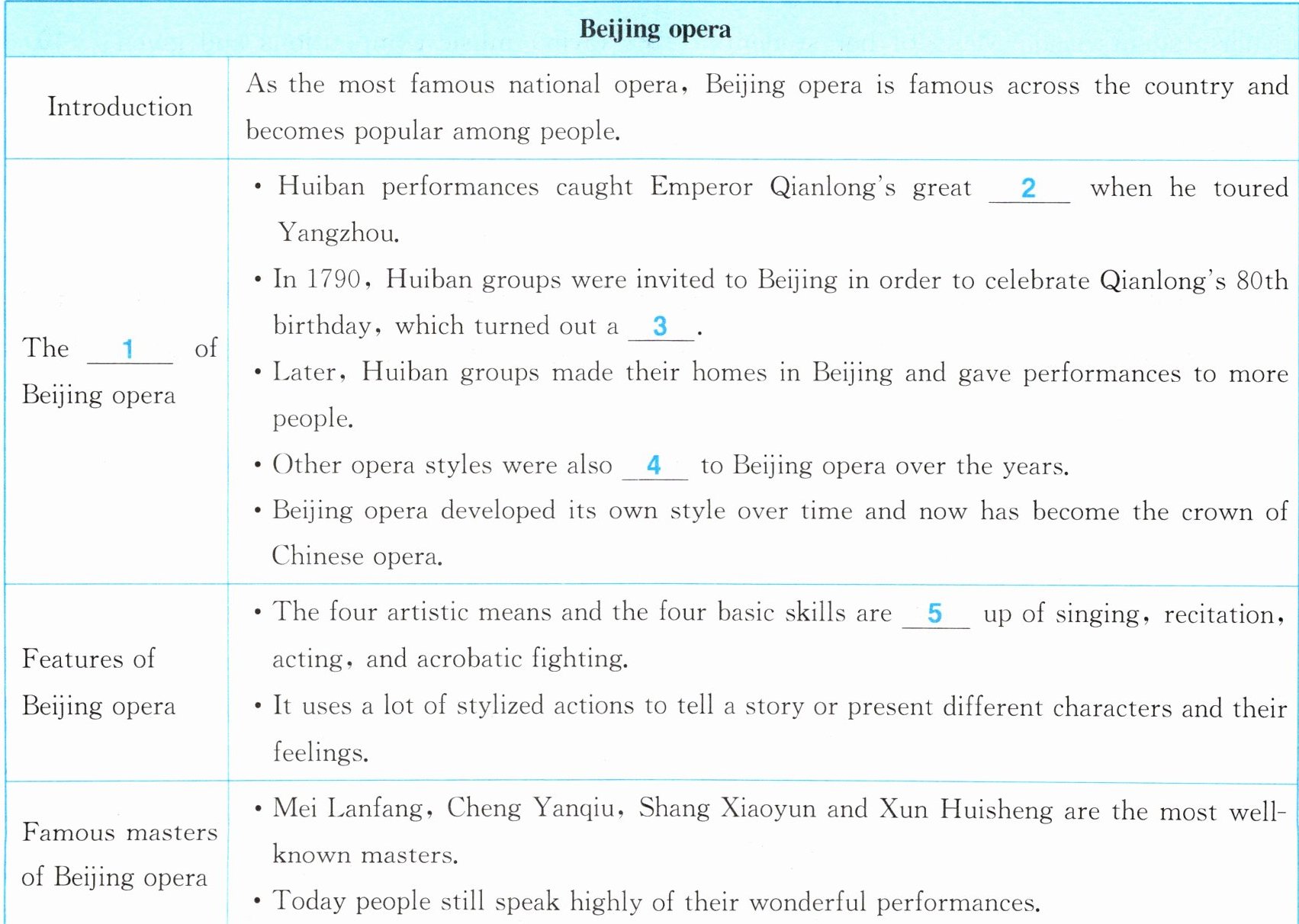
to Beijing opera over the years.
• Beijing opera developed its own style over time and now has become the crown of Chinese opera. |
| Features of Beijing opera |$ • The four artistic means and the four basic skills are \underline{ 5 } up of singing, recitation, acting, and acrobatic fighting.$
• It uses a lot of stylized actions to tell a story or present different characters and their feelings. |
| Famous masters of Beijing opera | • Mei Lanfang, Cheng Yanqiu, Shang Xiaoyun and Xun Huisheng are the most well-known masters.
• Today people still speak highly of their wonderful performances. |
续表

1.
history/origin/development
2.
attention/interest
3.
success
4.
added/introduced
5.
made
6.
alive
7.
doubt
8.
I will watch Beijing opera performances and introduce them to my foreign friends.(答案不唯一,言之有理即可)