二、班主任王老师给同学们推荐了《南京照相馆》这部直击心灵的电影。一起来看看电影中有哪些震撼人心的情节。
While many war films show huge battlefields, a new Chinese movie, Dead to Rights (or Nanjing Photo Studio), tells a powerful story from a small, quiet place—a photo studio during the painful Nanjing Massacre of 1937. In the city filled with danger, ordinary people hide in Jixiang Photo Studio for safety. A young postman pretends to be a photography apprentice(学徒) there. When forced to develop photos for Japanese soldiers, he discovers pictures that record their terrible crimes. What begins as a fight to survive slowly turns into a brave mission: to protect this solid evidence of history and pass on the truth, no matter the cost. The film is special because it shows "big history through small people". It uses careful details—like realistic sets and local dialect—to make the past feel real and close to us. The most touching moments connect deeply with the audience: when the studio owner firmly says, "Not a single inch of our beautiful land shall be given up," or when scenes of modern Nanjing streets are mixed with wartime ruins, we see not just history, but the unbroken spirit of a civilization. Dead to Rights doesn't rely on large fight scenes. Instead, it uses the quiet space of a photo studio to show how common people awake and resist. It helps us feel the great sacrifices made to protect truth and dignity. The title itself reminds us that solid evidence, guarded by courage, calls on us to remember the past and value the peace we have today.
(一)Complete the mind map with the information from the text.
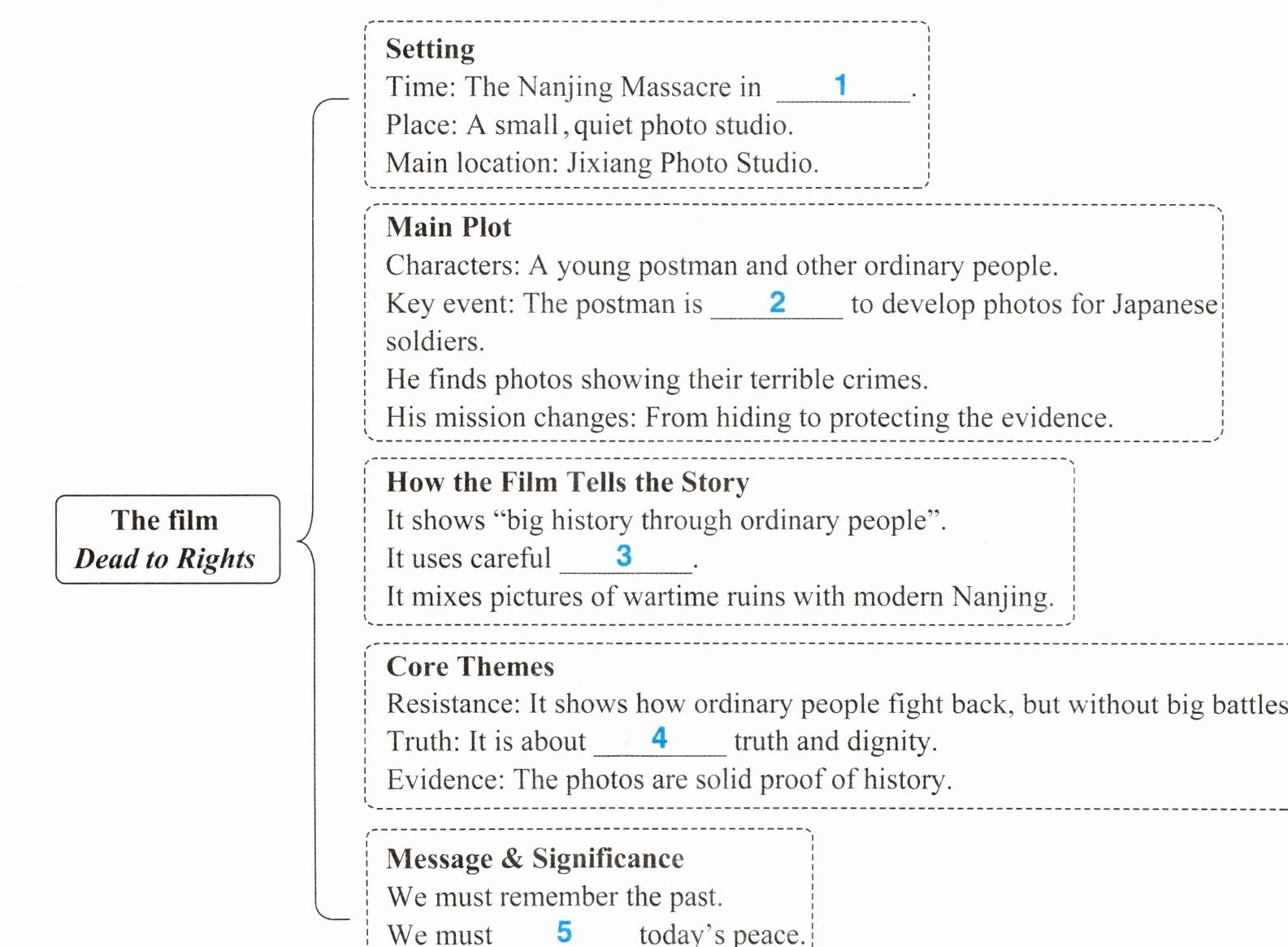
1.
1937
2.
forced
3.
details
4.
protecting
5.
value
(二)Choose the right answer.
(
B
)1. Where does most of the story take place?
A. On a large battlefield.
B. In a photo studio.
C. On modern Nanjing streets.
D. In a Japanese army office.
(
B
)2.
新考法 写作手法 How does the film show the "big history"?
A. With famous historical people.
B. Through stories of ordinary people.
C. With large fight scenes.
D. Through soldiers' conversations.
(
B
)3. Why should we remember the past according to the film?
A. To make better movies.
B. To value today's peace.
C. To build new studios.
D. To learn photography.
(
B
)4.
新考法 组合选择 What helps the film become successful?
① Realistic sets and local dialect.
② Big and exciting war scenes.
③ The story of "small people and great history".
④ Its connection with audience's feelings.
A. ①②③
B. ①③④
C. ②③④
D. ①②④
(
C
)5. Where can we most likely read this passage?
A. In a history textbook chapter.
B. In a travel guide to Nanjing.
C. In a film review or cultural article.
D. In a photography technique magazine.
(三)Answer the questions according to the text.
1. Why does the postman hide in Jixiang Photo Studio?
To find a safe place and later to protect the evidence of crimes/history and pass on the truth.
2. What does the film mainly want to tell us?
It mainly tells us the story of "small people and history", reminds us to remember the past, value peace and feel the spirit of resisting and protecting truth and dignity.(围绕文章最后三句话进行总结即可)