零五网 全部参考答案 通城学典课时作业本答案 2026年通成学典课时作业本八年级英语上册译林版江苏专版 第53页解析答案
第二节 跨学科 地理 阅读下面短文,从短文后的选项中选出可以填入空白处的最佳选项。选项中有一项为多余选项。(每小题1分,共5分)
Everybody knows that there are usually four seasons in a year. 11.
D

As our planet moves around the sun, the light from the sun falls on the earth from different directions. This helps create the seasons. At different times of year, there is more sunlight in some places and less sunlight in others. More sunlight means longer days and warmer weather.
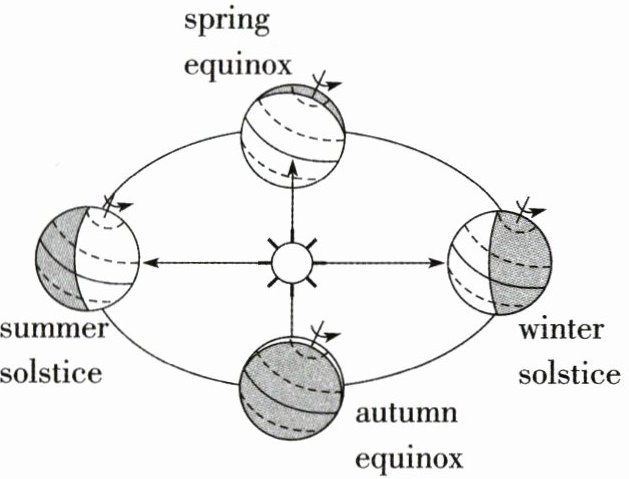
12.
A
It gets colder in autumn and winter because the days are shorter, and we get less light from the sun.
The seasons fall at different times of year around the world. For example, China is to the north of the equator(赤道). Here, we experience summer from June to August. 13.
F
In Australia, it is summer from December to February, and Australians have their spring when we have our autumn.
14.
E
The hottest and the coldest parts of the world usually have only two seasons. It is always hot in places close to the equator. These places are called the tropics(热带地区). Instead of our four seasons, many parts of the tropics have the rainy season and the dry season.
15.
C
Around the North and South Poles, there are only two seasons, too: a very, very cold winter and a somewhat less cold summer.
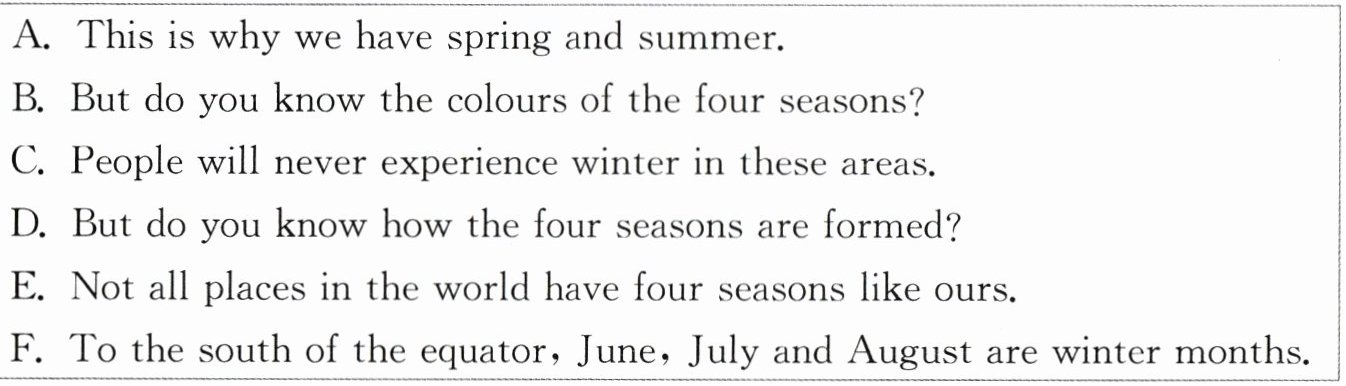
A. This is why we have spring and summer.
B. But do you know the colours of the four seasons?
C. People will never experience winter in these areas.
D. But do you know how the four seasons are formed?
E. Not all places in the world have four seasons like ours.
F. To the south of the equator, June, July and August are winter months.

答案:11. D 根据下文“As our planet moves around the sun, the light from the sun falls on the earth from different directions. This helps create the seasons ...”可知,此处解释季节形成的原因,选项D“但是你知道四季是怎么形成的吗?”符合语境。
12. A 根据上文“At different times of year, there is more sunlight in some places and less sunlight in others. More sunlight means longer days and warmer weather.”并结合选项可知,有些地方阳光较多,更多的阳光意味着更长的白天和更温暖的天气,即指春天和夏天,选项 A“这就是为什么我们有春天和夏天。”符合语境。
13. F 根据上文“The seasons fall at different times of year around the world.”并通读本段可知,此处介绍南北半球季节的不同,选项 F“在赤道以南,六月、七月和八月是冬季。”符合语境。
14. E 根据下文“The hottest and the coldest parts of the world usually have only two seasons.”可知,有些地方只有两个季节,选项E“并不是世界上所有的地方都有像我们这样的四季。”符合语境。
15. C 根据上文“The hottest and the coldest parts of the world usually have only two seasons ... Instead of our four seasons, many parts of the tropics have the rainy season and the dry season.”并结合选项可知,这些地方的人不会经历冬天,选项 C“在这些地区,人们永远不会经历冬天。”符合语境。
解析:
【分析】
这是一道跨地理学科的阅读补全题,解题时首先通读全文,明确文章核心围绕四季的形成原理、全球不同区域的季节分布差异展开。接下来逐空定位前后文的逻辑关联:
1. 第11空后文紧接着开始解释地球公转、太阳光线角度变化催生四季的原理,说明空格处需要一个引出“四季形成原因”的设问,匹配对应选项;
2. 第12空前文提到“更多的日照意味着更长的白昼、更温暖的天气”,后文转而介绍秋冬日照少气温低,空格处需要衔接前文的多日照对应的季节,完成逻辑过渡;
3. 第13空所在段核心说明全球不同区域季节时间不同,前文举了北半球中国6-8月为夏季的例子,后文举澳大利亚的季节情况,空格处需要补充南半球的季节特征,形成南北半球的对照;
4. 第14空后文介绍最热、最冷的区域都只有2个季节,空格处需要一个总起句,引出“不是所有区域都有四季”的核心观点;
5. 第15空前文介绍热带区域只有雨季和旱季,空格处补充热带区域的季节特点,再顺承引出极地的两季特征。最后验证剩余选项,全文没有提及四季的颜色相关内容,排除多余选项B即可。
【解析】
11. 根据空后内容“地球绕太阳运转,太阳光线从不同角度照射地球,催生了四季”,可知此处是引出四季形成原理的设问,选项D“但是你知道四季是怎么形成的吗?”符合语境。
12. 空前说明更多日照对应更长白昼、更温暖的天气,空后说明秋冬日照少气温低,空格处衔接多日照对应的季节,选项A“这就是为什么我们有春天和夏天”,完成前后逻辑过渡,符合语境。
13. 本段核心介绍南北半球季节相反的特征,空前举了北半球中国6-8月为夏季的例子,选项F“在赤道以南,六月、七月和八月是冬季”,刚好对应南半球的季节特征,和后文澳大利亚的季节介绍呼应,符合语境。
14. 空后介绍热带、极地这类区域都只有2个季节,空格处作为段首总起句,选项E“并不是世界上所有的地方都有像我们这样的四季”,引出后文的分述内容,符合语境。
15. 空前说明热带区域只有雨季和旱季,没有常规的春夏秋冬四季,选项C“在这些地区,人们永远不会经历冬天”,承接热带区域的季节特点,再顺承引出极地的两季介绍,符合语境。
多余选项B提到四季的颜色,全文没有相关内容,为干扰项。
【答案】
11. D 12. A 13. F 14. E 15. C
【知识点】
英语阅读逻辑衔接、跨学科地理常识、语篇信息匹配
【点评】
本题属于跨地理学科的阅读题型,既考察学生梳理英语语篇上下文逻辑、抓取前后句关联信息的能力,也结合了南北半球季节差异、热带极地气候特征的基础地理常识,学生可以借助学科联动的知识快速锁定答案,整体命题灵活,没有设置过于晦涩的干扰项。
【难度系数】
0.7
四、用所给词的适当形式填空。(每小题1分,共5分)
1. On
foggy
(fog) days, I love wearing my bright yellow jacket so my friends can spot me easily.
2. The
snowman's
(snowman) body was melting in the warm sun, so we quickly took a photo.
3. Feel free
to leave
(leave) early if you finish your work.
4. She was walking home when
suddenly
(sudden) a dog ran towards her.
5. The teacher came into the classroom,
holding
(hold) a pile of exercise books in her hand.
答案:1. foggy 2. snowman's 3. to leave 4. suddenly 5. holding
解析:
【分析】
做这类用所给词适当形式填空的题目,核心思路是先分析空格所在位置的句子成分,判断空格处需要的词性或对应的语法功能,再结合词性转换规则、固定搭配、相关语法规则推导正确形式:
1. 第一题空格后是名词days,需要修饰名词的形容词;
2. 第二题空格后是名词body,要表达所属含义,需要用名词所有格;
3. 第三题直接联想对应的固定搭配结构;
4. 第四题空格修饰后续整个句子,需要作状语的副词;
5. 第五题句中已有谓语动词,空格的动作是伴随主句动作同时发生的主动动作,需要用现在分词作伴随状语。
【解析】
1. 空格后为可数名词复数days,需用形容词作定语修饰名词,名词fog的形容词形式为foggy,意为“有雾的”,故填foggy。
2. 空格后为名词body,此处要表达“雪人的身体”的所属含义,单数名词snowman的所有格直接在词尾加's,故填snowman's。
3. 本题考查固定搭配feel free to do sth,意为“随意做某事”,因此空格处要填动词不定式形式,故填to leave。
4. 空格用于修饰后面整个句子“a dog ran towards her”,需用副词作状语,形容词sudden的副词形式为suddenly,意为“突然地”,故填suddenly。
5. 句中已有谓语动词came into,空格处的动作是伴随主句谓语同时发生的主动动作,主语the teacher和动词hold为主动关系,需用现在分词作伴随状语,故填holding。
【答案】
1. foggy 2. snowman's 3. to leave 4. suddenly 5. holding
【知识点】
词形转换,固定搭配,非谓语动词
【点评】
本题属于初中英语基础词法句法综合填空题,考点覆盖了形容词修饰名词、名词所有格、固定短语、副词作状语、现在分词伴随状语多个核心基础知识点,只要学生能准确分析句子成分、牢记常见词性变形规则和基础语法点,就可以顺利完成作答。
【难度系数】
0.7
上一页 下一页