四、阅读理解。(24分)
A(2025·连云港)
新素材 传统文化 An hour before the show, the backstage(后台) was busy and noisy. Young male Beijing opera artists in their 20s were
applying makeup, adjusting costumes, stretching, and clearing their throats. The air was filled with the sounds of traditional Chinese instruments.
“These young people started learning with me when they were just kids—now they’re

adults, leading the shows themselves,” says Yang Shaochun, an 85-year-old Beijing opera master.
This weekend, four shows will be put on at Beijing People’s Theatre. Young wuxi artists will play the lead roles.
Wuxi, or martial(武术的) play, is the base of the fighting and movement part in Beijing opera. Wei Pengyu, a 29-year-old actor, was attracted to Beijing opera as a child—not by the music or stories at first, but by the colourful, amazing facial masks that brought the characters to life. At 14, he began training in Beijing opera, especially in wusheng—a male role type. “For me, stepping into the role of a hero is a dream come true,” he says.
“Playing wuxi isn’t just about action—it’s about expressing the character’s courage, justice(正义), loyalty and strength through movements,” says Xu Zhouyi, 25, another male actor.
Later that evening, a classic piece San Cha Kou was played by two young actors, Wu Zeyu and Shu Jiaxing. The viewers were attracted to the great scene and cheered for the actors’ excellent martial art movements.
Wu and Shu practised together for nearly a year. “San Cha Kou is a test of trust between two actors. We have to read each other’s energy—know when one is speeding up or slowing down. Every movement must be perfectly counted to avoid real crashes while still looking dangerous,” says Wu.
(
B
)1. What does the underlined part mean in Paragraph 1?
A. Asking the master for help. B. Getting ready for the show.
C. Having a martial art lesson. D. Learning a new instrument.
(
C
)2. Why does the writer mention Wei Pengyu and Xu Zhouyi?
A. To share their life experiences.
B. To compare their training results.
C. To show their understanding of wuxi.
D. To express their love for facial masks.
(
A
)3. What message can we learn from the successful show of San Cha Kou?
A. Practice makes perfect. B. One is never too old to learn.
C. Great hopes make great man. D. Friends should be few but good.
(
B
)4. What is a suitable title for the text?
A. Wuxi movements impress viewers
B. Young actors shine in Beijing opera
C. Wuxi actors celebrate after graduating
D. A Beijing opera master opens a school
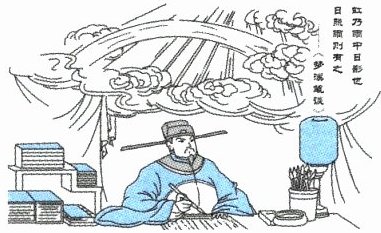
Born in Zhejiang Province, Shen Kuo was an excellent scientist of the Northern Song dynasty. He was a gifted scholar of literature, physics, chemistry, calendar, medical science and many other fields. In his life, Shen held a number of official positions. He once represented the government to the Liao Kingdom and led soldiers in battle. At one time, he served as the director to watch the stars. So, Shen Kuo was well-known for his amazing talent in ancient China.
Shen Kuo was especially known for the explanations of natural phenomena found in his famous book Mengxi Bitan, or Dream Pool Essays. The book was widely regarded as an important scientific work in ancient China. There is a story about the origin of Mengxi Bitan. While in his thirties, Shen Kuo often dreamed of a place. In the dream, he climbed a hill, the top of which was covered with brightly coloured flowers and trees. A clear stream flowed at the foot of the hill. Later on, when travelling around, he was shocked to find a piece of land that was just the place in his dream. After his retirement, he remained there for the last seven years, naming it “Dream Brook Garden”, and wrote down the discoveries he had made in his lifetime.
In Mengxi Bitan, he wrote a lot about the animals and plants he had seen when travelling through the country, such as the giant clam(蛤蜊) in the South Sea, the crocodile in Chaozhou and Chinese wolfberries in the northwest of China. The book also introduced some methods to kill insect pests.
Shen Kuo was the first to discover that the compass does not point directly north, but to the north magnetic pole(北磁极). He also had deep knowledge about fossils. When visiting the Taihang Mountains in Shanxi Province, he found fossilized seashells and noted the egg-shaped stones like those were often found in the area by the sea. This led him to conclude that at some time in the distant past, Shanxi had been covered by the sea.
Shen Kuo was hundreds of years ahead of Western scientists in many fields. His work Mengxi Bitan was a milestone in the history of Chinese science. Today, this amazing over 900-year-old work has been translated into a number of different languages.
(
B
)5. What do we know about Mengxi Bitan?
A. It described Shen Kuo’s dreams.
B. Its name came from the place in his dream.
C. It was one of Shen’s 1,000 scientific works.
D. Mengxi Bitan or Dream Pool Essays is about nature.
(
C
)6. Which of the following sayings can best describe Shen Kuo?
A. Like father, like son. B. Silence is gold.
C. Good at both pen and sword. D. Practice makes perfect.
(
D
)7. What does the underlined word “This” in Paragraph 4 mean?
A. Shanxi was covered by the sea long ago.
B. The compass points directly to the north.
C. Shen Kuo visited the Taihang Mountains in Shanxi.
D. Egg-shaped fossils were found in Shanxi.