A(2025·扬州)
新素材 人文地理 Alex and his classmates are working on a project about the Great Lakes. Here is the information sheet they have made.
Part 1: Facts
The Great Lakes—Ontario, Huron, Michigan, Erie and Superior—are five freshwater giants. They span across eight US states and two Canadian provinces.
Part 2: Comparison
• Lake Ontario
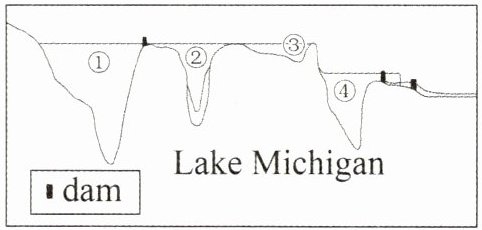
This lake has the smallest surface area at 7,336 square miles. Three dams(大坝) control the flow of water downstream and include locks so boats can enter from the Atlantic.
• Lake Huron
This is the second largest lake by surface area in the system and home to Manitoulin Island, the world’s largest freshwater island.
• Lake Michigan
It is joined to Lake Huron by the five-mile-wide Straits(海峡) of Mackinac, though they are still classed as two separate bodies.
• Lake Erie
With a depth of 64 metres, this is the shallowest of the Great Lakes. It is generally the warmest, but also gets frozen more quickly than the others.
• Lake Superior
At 406 metres deep, the distance from the lake’s surface to its deepest point is about the same as the length of four football pitches.
Part 3:
Covering an area of 94,250 square miles, these huge bodies of water take up more than one-fifth of the world’s total freshwater. The Great Lakes provide drinking water for more than 40 million people, important shipping routes for more than 800 ocean ships, and keep a rich ecosystem for fishing and agriculture. They also support wildlife, the national economy and the environment.
(
D
)1. 新考法 图示理解 Alex draws a map of the Great Lakes. Which number stands for Lake Ontario?
A. ① B. ②
C. ③ D. ④
(
B
)2. Alex wants to try ice fishing as early as possible. Which lake will he most probably choose?
A. Lake Superior. B. Lake Erie. C. Lake Michigan. D. Lake Huron.
(
A
)3. 新考法 单词回填 Alex finds something missing in Part 3. Which of the following will he put in the empty box?
A. Value B. Change C. Protection D. Development