答案:11.(1)证明:$\because$四边形ABCD是平行四边形,
$\therefore ∠ B=∠ D=60^{\circ},AB=CD=6a,AD=BC=6b.$
$\because BE=\frac{1}{2}AE,\therefore AB=AE+\frac{1}{2}AE,$
$\therefore AE=4a,BE=DG=2a,CG=4a.$
同理可得$AH=CF=2b,DH=BF=4b.$
在$△ DGH$和$△ BEF$中,
$\begin{cases} DH=BF,\\ ∠ D=∠ B,\\ DG=BE, \end{cases}$
$\therefore △ DGH≌ △ BEF(SAS),$
$\therefore GH=EF$,同理可得$△ AEH≌ △ CGF(SAS),$
$\therefore EH=GF,$
$\therefore$四边形EFGH是平行四边形.
(2)解:如答图,分别过点H,F作$HP⊥ CD,FQ⊥ CD$,交直线CD于点P,Q.
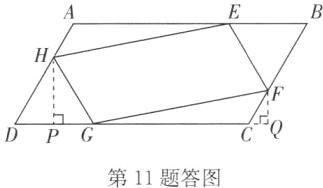
$\because$在平行四边形ABCD中,$AD// BC,$
$\therefore ∠ D=∠ BCQ=60^{\circ},$
$\therefore ∠ DHP=∠ CFQ=30^{\circ},$
$\therefore DP=\frac{1}{2}DH=2b,CQ=\frac{1}{2}CF=b,$
$\therefore PH=\sqrt{DH^{2}-DP^{2}}=2\sqrt{3}b,FQ=\sqrt{CF^{2}-CQ^{2}}=\sqrt{3}b,$
$\therefore PG=DG - DP=2a - 2b,QG=CG+QC=4a+b.$
$\because$四边形EFGH是菱形,
$\therefore GH=GF,$
$\therefore PG^{2}+PH^{2}=QG^{2}+FQ^{2},$
$\therefore (2a - 2b)^{2}+(2\sqrt{3}b)^{2}=(4a+b)^{2}+(\sqrt{3}b)^{2},$
化简,得$12a^{2}+16ab - 12b^{2}=0,$
即$3b^{2}-3a^{2}=4ab,$
两边同除以3ab,得$\frac{b}{a}-\frac{a}{b}=\frac{4}{3}.$
(3)解:不能,理由如下:
如答图,若四边形EFGH是正方形,则$HG=FG,∠ HGF=90^{\circ},$
$\therefore ∠ HGP+∠ FGQ=90^{\circ}.$
$\because HP⊥ CD,\therefore ∠ HGP+∠ GHP=90^{\circ},$
$\therefore ∠ FGQ=∠ GHP.$
在$△ PHG$和$△ QGF$中,
$\begin{cases} ∠ HPG=∠ GQF,\\ ∠ PHG=∠ QGF,\\ HG=GF, \end{cases}$
$\therefore △ PHG≌ △ QGF(AAS),$
$\therefore HP=GQ,PG=QF,$
$\therefore 2\sqrt{3}b=4a+b,2a - 2b=\sqrt{3}b,$
解得$a=0,b=0,$
$\therefore$四边形EFGH不能为正方形.